

Method Notes No. 11: What needs to stop, or - what I mean by that
I suspected this blog post would be long; let's get started.
A few days ago I published a post called "Things that need to stop in portrait photography".
I was of course aware that the title was a bit provocative. Otherwise, I would have called it something else.
What I hadn't expected was some of the response I received afterward. Not even necessarily in the public comments. It was mostly direct messages on Instagram, and a few emails. Some of them were really long. Not three sentences, but what felt like pages.
And most of it was surprisingly personal.
Photographers have told me about their own development, about things they eventually started questioning themselves. Models have written to me and described situations they've experienced. Others have said: I completely agree with you on one point, but I don't understand the other. Or: That sentence resonated with me, but I don't yet know exactly why.
And then you write back and forth a bit and try to find out together what actually just happened.
I really liked that.
And not just if or because someone agreed with me. That wouldn't be enough motivation for me to write such a post.
But because someone takes an idea and applies it to their own work. It fits. It doesn't fit. It's annoying at first. It triggers something. You start thinking about it.
That was precisely the point.
But of course, there was also the other side.
I think some people were already finished with the post after the first slide.
"What needs to stop? Who are you to tell me what needs to stop?"
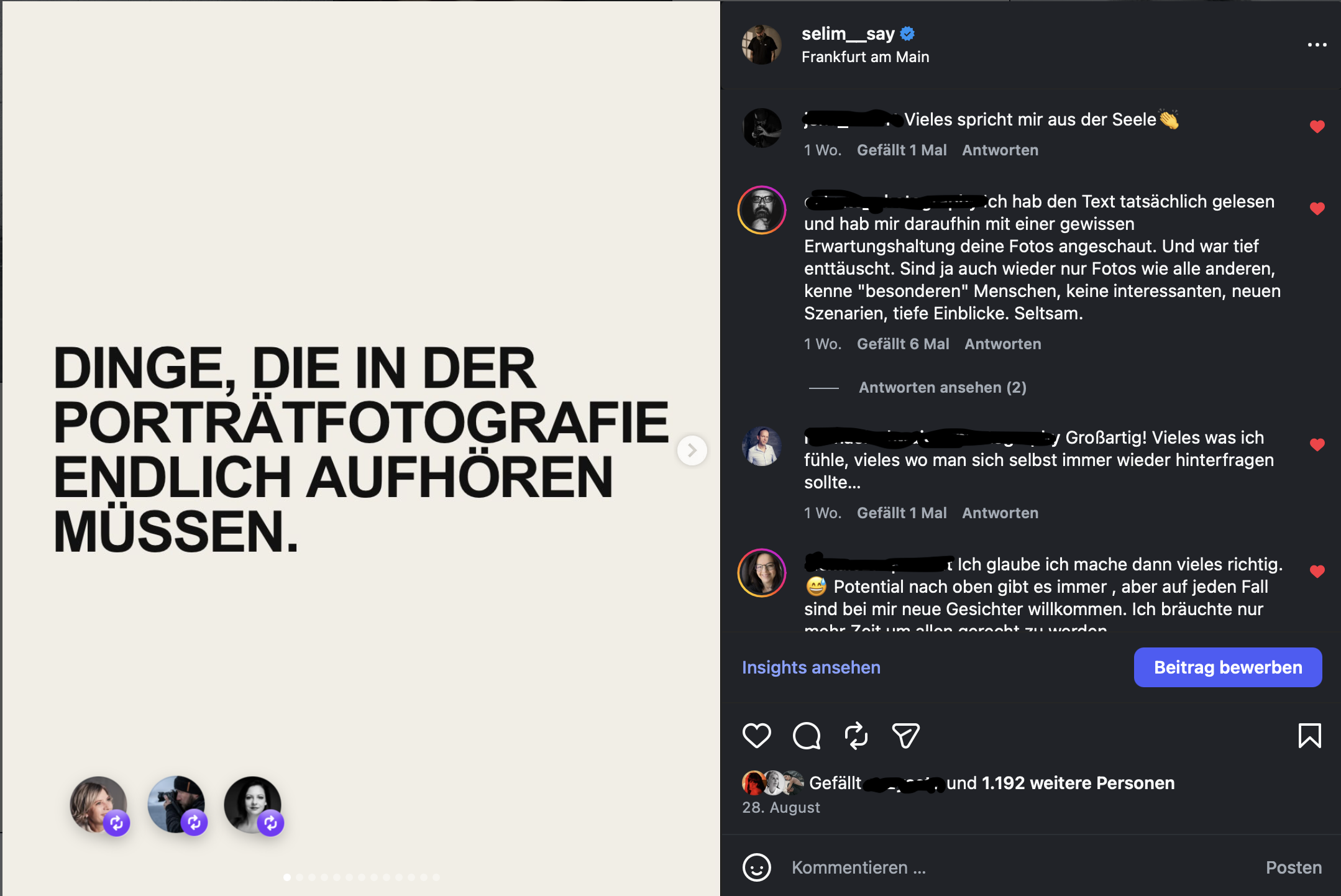
The comments ranged from "I won't let anyone tell me what to photograph" to "Art can do anything" to the statement that photographers should actually stop trying to tell other photographers what is right or wrong.
That's one way to look at it.
What I found more interesting was a pattern that ran through a surprisingly large number of these critical comments and messages.
At some point, it was no longer about what I had written.
Then we talked about my pictures.
My pictures themselves weren't considered particularly good. My style wasn't consistent. My editing contradicted what I wrote. And in some cases, even the people I photographed received rather unflattering reviews.
I found that remarkable. Truly. Recognizing the pattern was fascinating.
Naturally, one becomes curious and checks out who is actually writing to you.
And with some, it was clear to me after just a few pictures: Okay. We are simply very, very far apart.
In terms of taste, aesthetics, and probably also in our understanding of why we photograph people at all.
And that's perfectly okay.
I'm not asking for a change in taste.
Quite the opposite.
I don't want everyone to like the same pictures. Nor do I want everyone to photograph the way I do. That would be absurd. I don't even always photograph the same way myself. That was also the clear point of one of my statements in my post.
If someone finds my pictures insignificant and I find theirs terrible, then we simply won't click. I'm perfectly fine with that. Life is full of situations like that.
I found those works more interesting where I looked at them and thought: That's really good.
And there, too, were some who were so bothered by the phrase "What must stop" that the actual content became almost secondary.
And I don't quite understand that.
Just because someone takes excellent pictures doesn't exempt them from occasionally observing their own work.
That applies to me as well.
That was basically the whole post.
The model and photographer carousel
I wrote on a slide about the model and photographer carousel.
"Always the same faces, always the same names, always the same group. At some point, curiosity turns into mere collecting."
I think anyone who's been around this scene for a while knows roughly what I mean.
A new face appears somewhere. One photographer spots it, then another, then yet another. And eventually, you see this person everywhere.
That alone is not the problem at all.
Ten good photographers can photograph the same person and see ten completely different things.
What interests me about this is the dynamic that sometimes arises afterwards.
Photographers look to see who other photographers are currently photographing. They want to capture that new face, too. And models, of course, look the other way: She was with him, she was with him, and now she's with him – I should go there as well.
And at some point, this thing almost turns by itself.
It's sometimes a bit like a truffle pig. Everyone is looking for the next special face, while at the same time everyone is taking their cues from what others have already declared special.
And that's why I thought the question on the slide was important:
Would you still want to photograph this person if no one knew who they were?
That's really all there is to it.
That doesn't mean you have to stop photographing famous models. Of course not.
But it's still okay to ask yourself this question every now and then.
Because while we are all looking in the same direction, there may be people walking past us who would be much more interesting to photograph.
We just never looked a second time.
Range is not a reason for a picture
For me, this is directly related to social media.
Of course, range has acquired a value.
A model with 50,000 or 100,000 followers brings something that someone with 500 followers doesn't: attention.
But attention doesn't automatically make someone a more interesting subject.
I have often seen people being photographed where I wonder if the photographer would have approached them if it weren't for this reach.
And it works the other way around too.
Models want to work with certain photographers because their names mean something. Because it makes them feel like they belong. Because other famous models have already been there.
That's all acceptable too.
I'm not naive. We use Instagram, we publish our work, we're happy about the reach. Me too.
I just think that one shouldn't confuse the two.
Range is range.
Photographic interest is photographic interest.
And sometimes it's quite interesting to consider which of these factors actually influenced the decision.
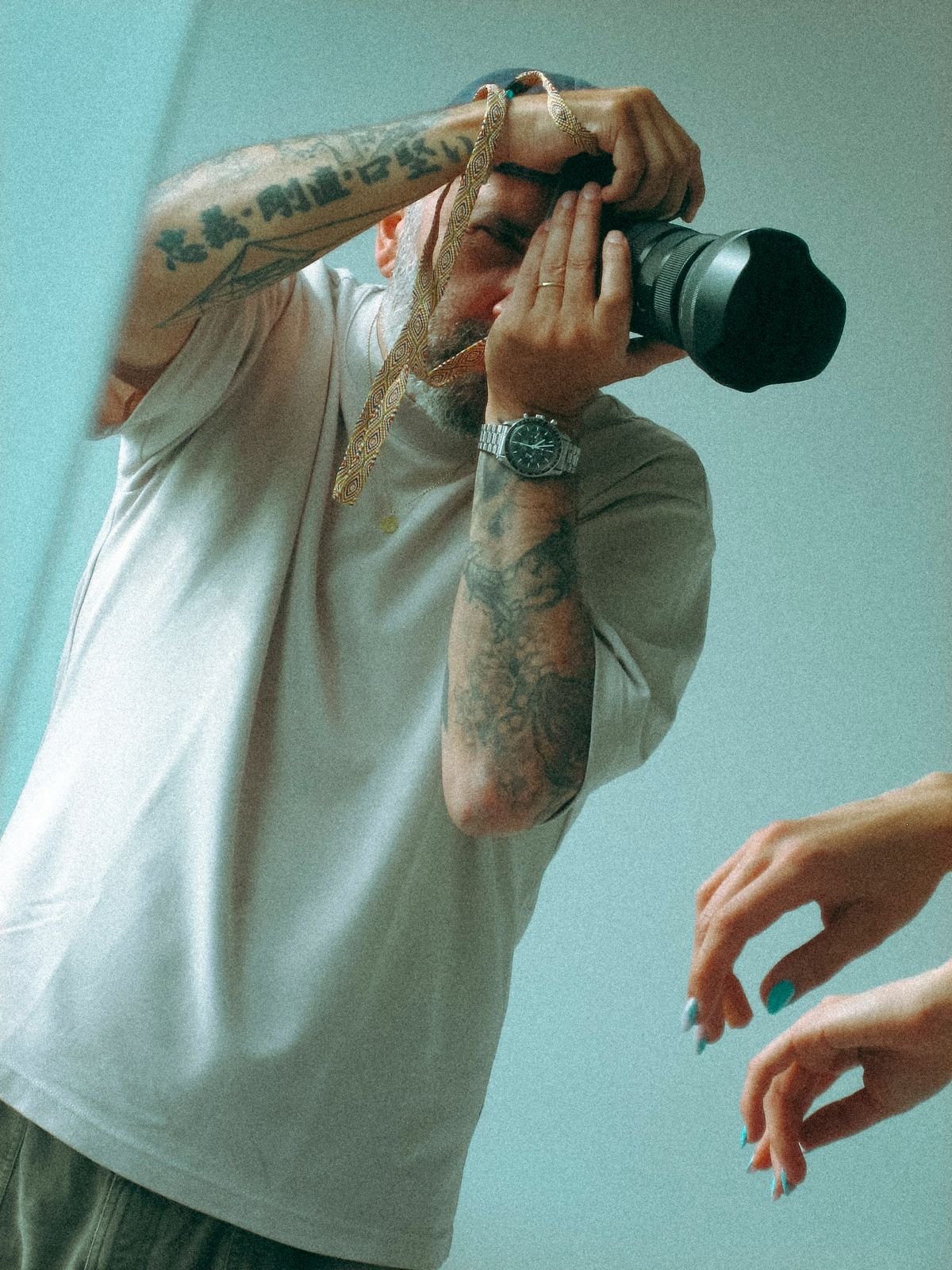
Photogenic. Or just used to it?
The next point was one that had been on my mind for a while.
"Too normal."
"Too old."
"Not the right figure."
"Not my type."
"The face means nothing to me."
Of course you're allowed to have a type. I do too.
But I think we should at least be careful that "photogenic" doesn't eventually become just another word for "I'm good at that." Or that it establishes a specific standard for attractiveness.
There are faces and bodies where we know pretty much exactly what works.
After a few minutes, you'll know which angle to photograph from, which light works, and how to position someone. You'll get a good shot relatively quickly.
But does that automatically make it more interesting?
It's precisely the face that I don't initially know what to make of that can be interesting.
Someone seems too well-behaved for my pictures at first glance.
Not edgy enough.
The figure doesn't match what we've trained ourselves to be particularly photogenic over the years.
And then I'll just have to try a little harder.
Not in the sense of: Now we're going to photograph all sorts of people for educational reasons, people we don't actually want to photograph.
That would be just as stupid.
But simply take another look.
Therefore, the question then arose:
How many people do we weed out before anything can even come into being?
I don't just ask them of others.
I ask myself that too.
Nudity does not make art
As expected, this was one of the points where things really got going.
And I must say: Even after all the news, I haven't changed my opinion too much.
I have absolutely no problem with nudity.
Anyone familiar with my paintings knows this.
I have photographed enough unclothed people and I am interested in physicality, closeness, vulnerability, intimacy and also sexuality in photography.
But precisely for that reason, I think it's permissible to differentiate.
There are images in which nudity has something to do with the person, the moment, or the story.
And there are images that rely mainly on the fact that someone is wearing little or nothing.
Undressing a woman in a lost place, a barn or a hotel room, styling her in a sexy way and photographing the whole thing in a provocative manner is not automatically courageous, intimate or art to me.
A good picture can result from this.
It could also just be really cheap.
And yes, it's a matter of taste. But not only that.
Because at some point it also becomes about what image of humanity I convey to the outside world through my pictures.
Especially those of us men who photograph women should ask ourselves this question a little more often.
What am I actually seeing here?
A human being?
A body?
A fantasy?
A projection surface?
And what of that do I then show the world?
By this I explicitly do not mean scenes or subcultures in which eroticism, fetishism, sexuality, roles or certain stagings are consciously part of a shared culture.
That's something completely different.
People experience things together. Relationships and friendships sometimes develop that may appear much more superficial from the outside than they actually are.
That's not what I'm talking about.
I'm talking about this thoughtless equation:
Nude + sexy + somehow edgy photographed = art.
No.
Not for me, anyway.
And the statement "But art is allowed to do that" doesn't change anything.
Of course she can.
And I'm still allowed to dislike it.
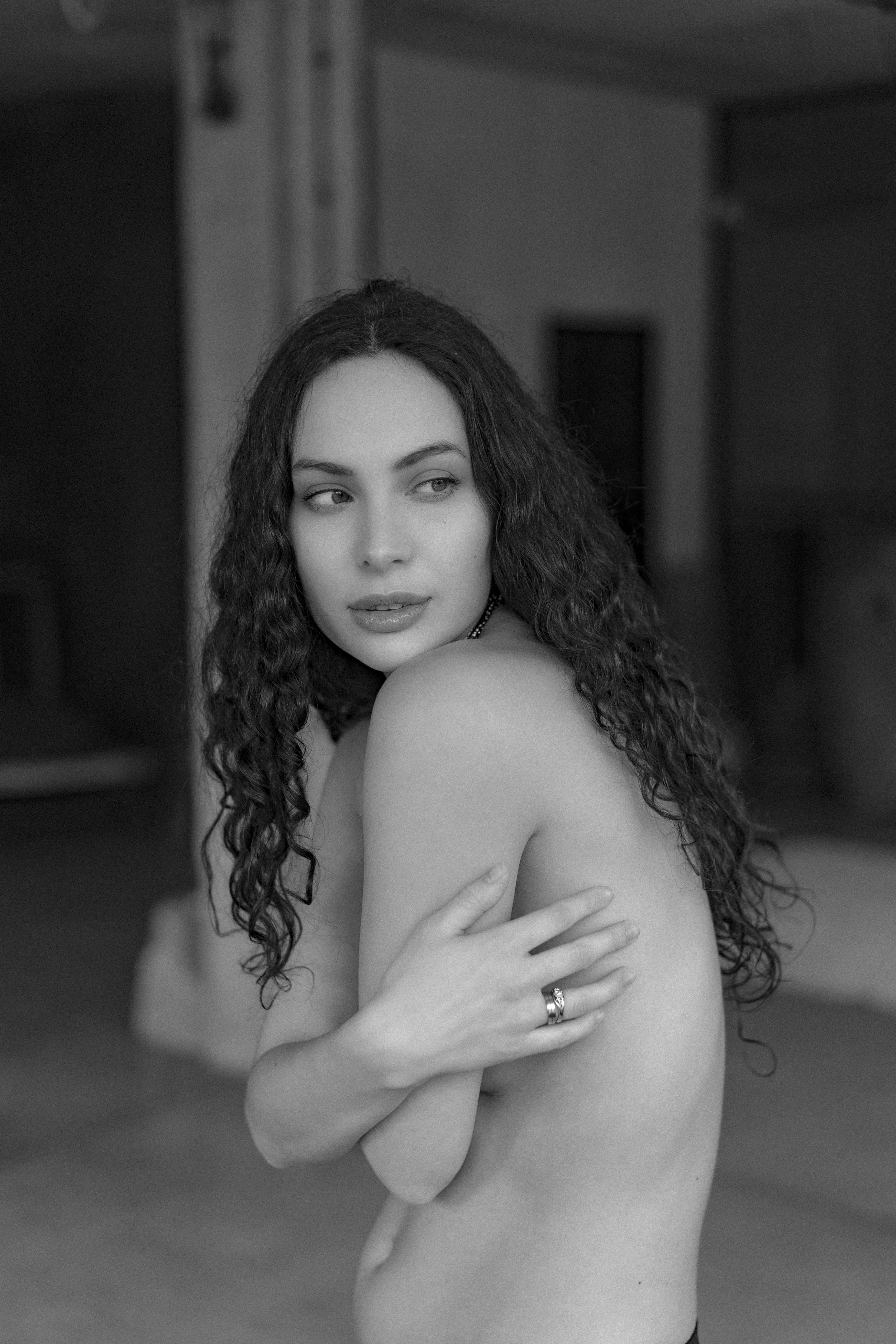
Victoria - Krakow 2026
Cover band photography
Another term from the post was cover band photography.
Canned footage.
Same lighting. Similar poses. Same gestures. Same editing. Next model.
Some people felt attacked there as well.
First, a distinction must be made.
Of course, there are photographers with an extremely distinctive style. You recognize a picture and know immediately who it's by.
That's great.
But handwriting and stencils are not the same thing to me.
When twenty different people ultimately produce twenty variations of the same image, I eventually start to wonder how much of those twenty people is actually still in it.
And I know that some of these photographers have an enormous appeal.
Models want to go there.
It's almost like a small knighthood. Now I have those pictures too. Now I've been there as well.
If that's exactly what someone wants: wonderful.
I personally want to take photos differently.
Something would be missing for me if the person in front of my camera simply had to fit into a pre-existing image concept.
And that's what the next slide was about:
Is this still an encounter or just output?
For me, that's pretty central.
I photograph people because I am interested in the encounter and because images result from it.
Of course, I want to have good pictures in the end.
I'm also disappointed if there's nothing there.
But I don't want to spend two hours with someone and then find out that this person was basically interchangeable.
You don't have to become a content creator just because you take photos
Incidentally, this is something I can observe myself in quite well right now.
I'm currently trying out a few things on Instagram.
I'm posting more. I'm trying out different topics. Seeing what works. Sometimes I don't like things afterwards, and at some point I might delete things again.
Everything okay.
I sometimes imagine social media as being like a submarine with sonar.
You send a signal out into this vast depth and see what comes back.
What creates resonance?
Where does something come back?
What simply disappears?
That can be quite helpful.
Things get difficult when this sonar eventually determines where you go.
You do something and it works.
So you do more of it.
It's working again.
Even more.
And at some point, you no longer really hear what interests you, because the echo from outside has become much louder.
I've seen this with photographers.
At some point, I had the feeling that it was no longer my own curiosity that was driving the development of my work, but mainly what social media had recently rewarded.
And you have to be careful about that.
Me too.
Likes can tell me what works for others.
They shouldn't tell me what I should find interesting.
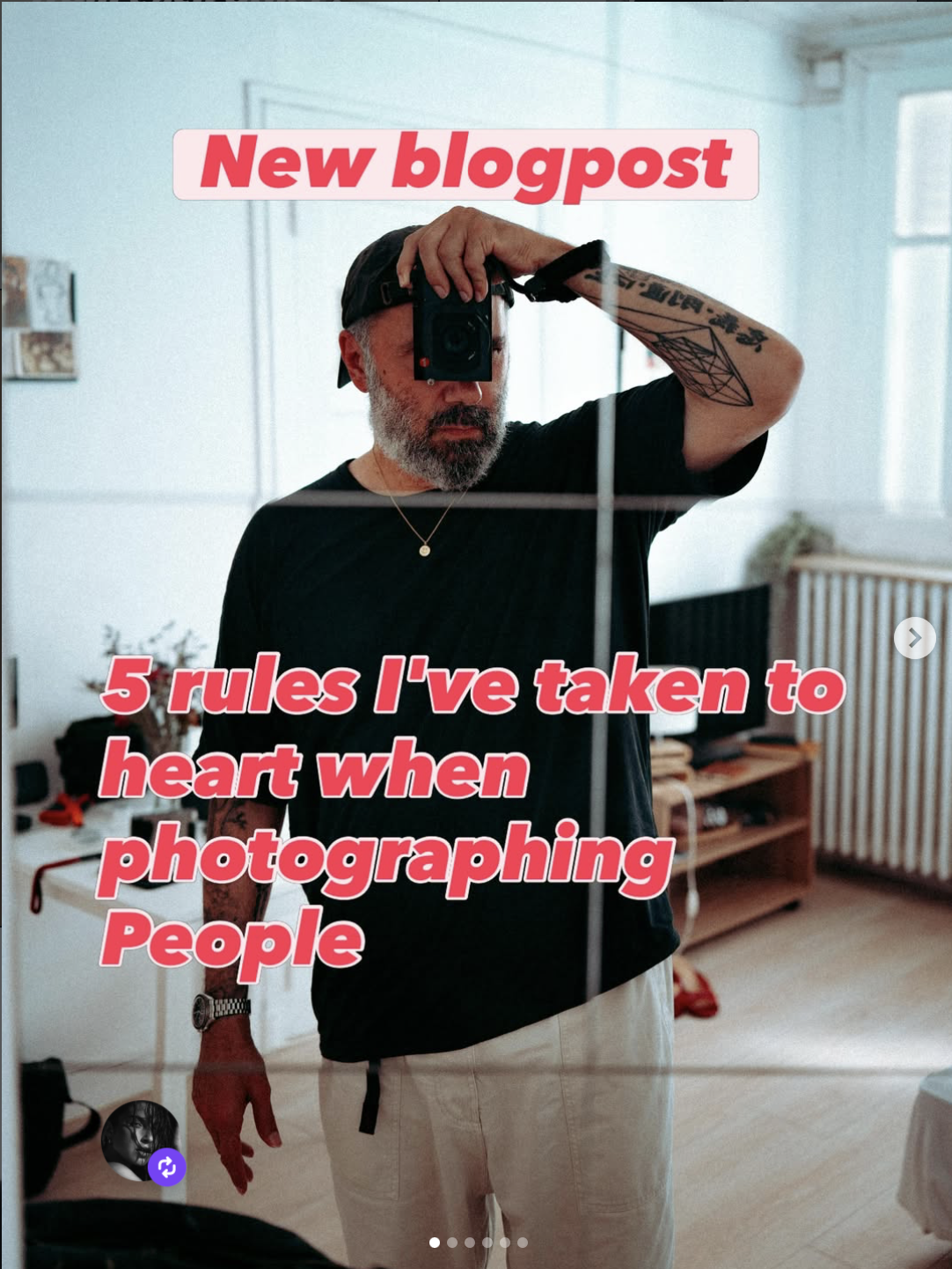
A preset is not a style
Several messages along these lines were received:
"But your pictures themselves have grain."
Yes.
They do.
And some may have received a bit too much.
And many are black and white. Some are in color. Others are quite unique because they are analog.
But that wasn't the point at all.
I never claimed that image editing is bad.
I also edit my pictures, of course.
What I mean is something else.
For me, style doesn't begin in Lightroom or Photoshop or any other image editing program.
It starts much earlier.
Regarding the question of who I actually want to photograph.
How to write to someone.
How I talk to a person.
How I create an atmosphere.
How much security I can provide.
How sensitive I am.
How close I get to someone.
What I perceive.
Which is something I deliberately don't photograph in the end.
How I think about it.
All of this is already part of the image long before any preset is applied.
Of course, editing can enhance something.
Grain can enhance atmosphere. Black and white can reduce something. Colors can change a mood.
But editing cannot replace something that was never present in the original image.
She can make it a real eye-catcher.
But that's not the same thing.
And of course, I've experimented with different looks myself. Naturally, you sometimes look to photographers you admire for inspiration.
For me, that's actually part of the development process.
For a while, you use a path that someone else has already walked.
But at some point you should realize whether you're still chasing after the flow or whether you've taken a different path yourself.
And me?
That's probably the point that has been completely lost in some of the reactions.
I'm not exempting myself from this whole post at all.
On the contrary.
I know some of these mechanisms quite well because I have experienced them myself.
I'm overshooting my target.
I take pictures that I think are good, and someone whose opinion I value asks me:
"What did you actually want with that?"
And sometimes that's a rather uncomfortably good question.
Or someone says:
"Why have you been doing that so often lately?"
Then I can of course say: That's just my style.
Or I ask myself for a moment:
Is that really style?
Is that handwriting?
Or am I just repeating myself?
I don't think you need to make a big artistic self-discovery drama out of it.
I also don't want to constantly analyze my own photography from a deep psychological perspective.
But checking in every now and then doesn't hurt.
What am I doing right now?
Why am I doing this?
And am I actually still where I want to be?
Not more.
So what needs to stop?
At the end of the post I asked:
"What needs to stop for you in portrait photography?"
Of course, this is meant rhetorically.
I don't expect everyone to go home, open their portfolio, and start cutting things.
And I'm not above portrait photography, handing out rules.
But I will not excuse the title retrospectively.
In my opinion, some things should stop.
Some things should be checked at least occasionally.
And in some things, especially where we work with other people and make pictures of them public, I also feel we have a certain responsibility.
What images of humanity do we present?
What beauty ideals do we keep repeating?
How do we treat the people who entrust themselves to us?
Who do we support?
Who do we give space to?
How do we talk to each other?
What do we give back?
All of this has to do with photography.
And no one is exempt from this just because they take excellent pictures.
Again: I am not demanding a change in taste.
That's important to me.
I don't want anyone to photograph like me. I don't want anyone to have to like my pictures. And I certainly don't want to define what constitutes art.
But what I disagree with is this blanket answer:
"This is art. It's allowed to be like this."
Yes.
That's allowed.
But that doesn't automatically say everything.
Art can be free and still be criticized.
An image may exist and I may still find it superficial.
Someone is allowed to photograph a woman in a certain way and I am still allowed to ask what image of women he is actually spreading.
A photographer can have the same look for ten years and I can still wonder whether that's a signature style or just repetition.
And of course, everyone is free to do the same with my work.
That's what I was getting at.
Not about rules.
Not about bans.
And it's not about everyone having the same answers in the end.
And then the next post came
In retrospect, I find it quite interesting that the post then went in a completely different direction.
There I tried to write about things that I find difficult to describe in portrait photography.
About closeness that sometimes arises for a brief moment.
About trust that suddenly appears.
About things someone tells you even though you didn't ask about them.
About that first glimpse of a picture, when someone sees themselves a little bit through your eyes.
And about what lingers for a while after an encounter.
For me, these two posts are quite closely related.
"What Must End" deals more with things I want less of. With routines, mechanisms, and developments that I realize are masking something for me.
The post that followed was about what I want more of.
And the second one probably explains the first one a bit better as a result.
Because in the end, I don't just want to remove things from photography.
My aim is to leave space for the reason why I photograph people in the first place.
For curiosity.
For encounters.
For trust.
For those difficult-to-explain moments that cannot be planned and that no algorithm can reliably reproduce.
If I had to reduce my original post to a question today, it would therefore not be:
What are you no longer allowed to photograph?
Rather:
Why do you do it that way?
Why this person?
Why always this guy?
Why this picture?
Why this nudity?
Why this edit?
Why am I interested in this?
And is the answer to that still coming from me?
Or am I now mainly listening to the echo that comes back from outside?
If someone asks themselves these questions and then comes to completely different answers than I do, that's perfectly fine.
This is not a matter of taste.
This is a conflict.
And that's exactly what I was getting at.