

Compendium Nº 2: Come Undone by Andreas Jorns
On break scenes, trust, and the happiness of the unplanned
I'm in France, in Annecy to be precise. Appointments during the day, business dinners in the evening – and I should really go straight to bed afterwards.
Instead, I sit down at the desk in my apartment, open my notebook, open my laptop, and begin to write. For two evenings, I stay up late into the night, compiling notes, typing, deleting, rewriting, and when I finally put my documents back in my bag, I am satisfied.
Because what I wanted to write about finally needed to be written down – after years of leafing through books, looking at them, and thinking about them.
We're talking about photography, Andreas Jorns and I.
But actually, we're talking about time. About trust. About working on something that only reveals itself when you stop posing.
We sit facing each other – separated by a few hundred kilometers, connected by a video call. In front of us each is a cup of coffee, behind us are shelves packed with books. We laugh when we notice the parallel.
I'm talking to Andreas about his photo book Come Undone – a project encompassing three years of photography, four years of traveling together, and countless moments that happen in between. Images that aren't planned, but emerge when nothing is required anymore.
I'm talking to him about this book as part of my small series on works that inspire and accompany me. These are photo books that I keep coming back to – also during workshops when the focus is on searching and finding in photography.
About books and compasses
We begin our conversation with literature. With the cultural “final bosses”, as we call them – Thomas Mann and his works, James Joyce, Ulysses.
Books that one struggles with on principle because they are too big to simply read.
Perhaps reading is a kind of compass for Andreas – as it is for me. A way to approach the world without wanting to capture it. For him, creating photo books seems to mark milestones along his photographic journey.
How I came to Come Undone
I myself was going through a period of change at the time.
My starting point – natural portrait and lifestyle photography using available light – had been shaped long enough by Peter Lindbergh and his contemporaries.
I was looking for the next element, a building block that told a story beyond simply showing surfaces.
Something more tangible, more honest, perhaps even more uncomfortable.
Something that revealed stories I couldn't yet fully articulate.
I remember exactly how I first saw the book – in an Instagram post, during a small introductory tour that Andreas undertook together with Katharina, his protagonist.
I ordered it immediately.
What captivated me was this calm, understated, yet intense energy between photographer and model. No poses, no effects, no model-like gestures – instead, a steady, earnest dialogue on equal footing. This evolved from photographer to model into a human-to-human relationship.

Source: ajorns.com
Apart from a brief introductory text, there are no explanatory words. The rest invites the viewer to read for themselves – intellectually, emotionally. Flipping through the pages becomes an inner reading: if one does more than simply flip through the pages, one can sense between the images what that time must have been like – what closeness, what silence, what uncertainties it held.
The title – music, meaning, Undine
The title "Come Undone" is a reference to the Duran Duran song. For Andreas, it represents more of a mood than a description—a kind of soundtrack to the project. He and Katharina are sitting together in a hotel lobby, brainstorming what to call the photo book. They come up with the same idea almost simultaneously.
“Come Undone means to me come as you are – unvarnished, unfinished, true,” says Andreas.
For him, the title represents letting go. It represents the moment when something dissolves – this relaxation and relinquishing of control, without the desire to please.
Over the years, my interpretation drifted in a different direction: towards the figure of Undine, the water nymph who can only become human when loved – and disappears when that trust is broken. She represents the unfathomable feminine, the aquatic, emotional, and elusive – beauty and transience at once. There is something fragile, something fleeting, about her. She embodies revealing herself and withdrawing again, the interplay of closeness and disappearance. As I said, I drifted off-topic.
Because, just like in Come Undone: a self-revelation under the condition of trust – and an awareness that trust is often only temporary.
And yet, as we both realized, Andreas' and my interpretations are two sides of the same truth:
Authenticity in photography cannot be forced. It reveals itself when you let go.
From posing to the break picture
In the beginning, everything was classic: studio sessions, fixed appointments, the usual "Today we're taking photos."
But soon the feeling arose: "This isn't really what we want, is it?".
The change came through travel – Usedom, later Mallorca. Fewer setups, more conversations, coffee, music. The camera was there, but it no longer intruded.
Andreas recounts how the atmosphere changed – away from photography, towards simply being.
"If nothing happens, that's okay. If something does happen, it could be great," he tells Katharina. And that's how they've lived for years.
Many of the pictures look as if they were taken during breaks – and often that's exactly what happened. While Katharina dried her hair, rolled a cigarette, gazed out the window. Lost in thought. And Andreas pressed the shutter.
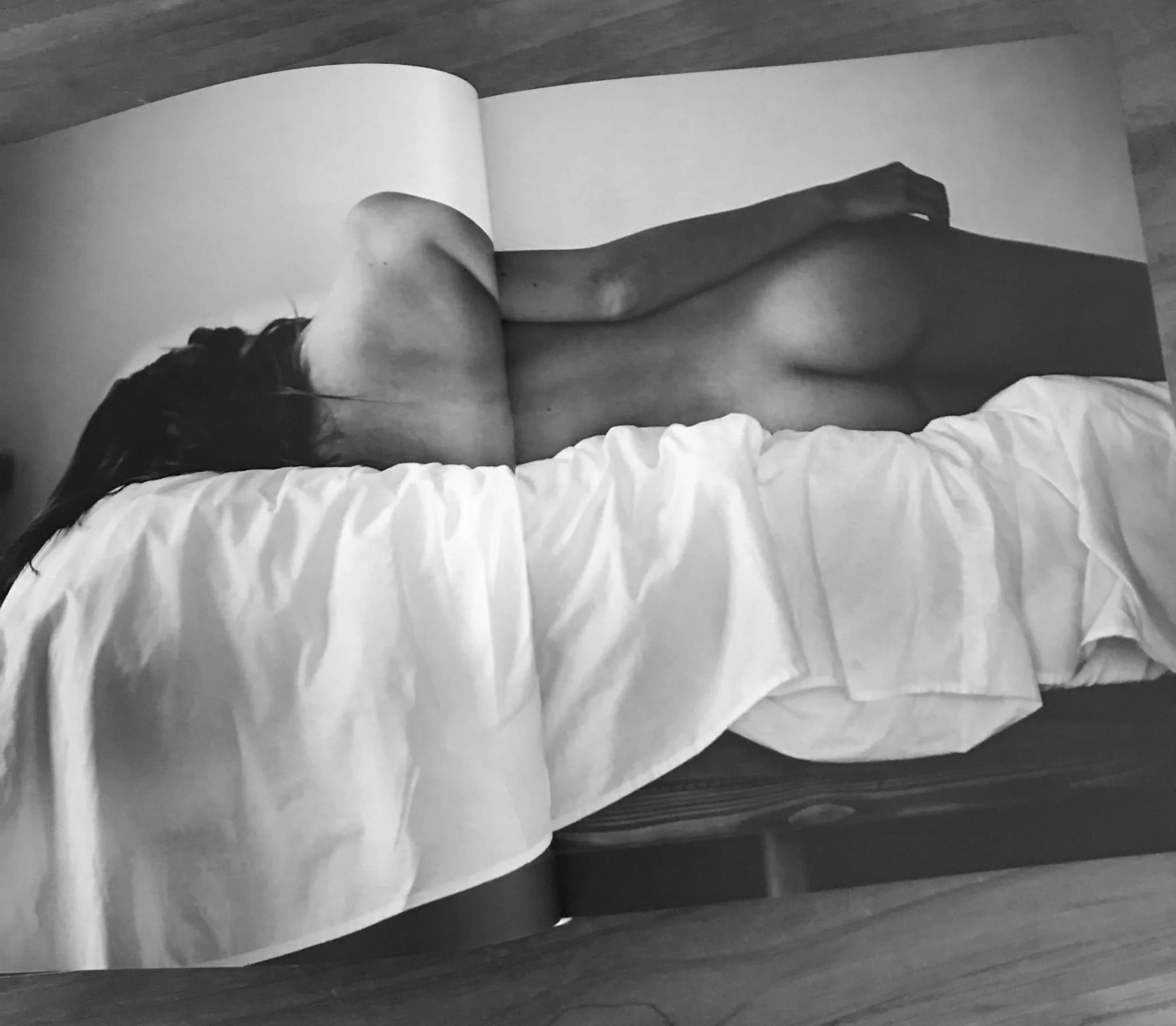
Source: ajorns.com
Katharina – brittle charm and quiet trust
Writing about "Come undone" without mentioning her, Katharina, would be impossible. I never met her, and yet, looking at the pictures, one has the feeling of having encountered her.
No routine, no self-promotion, no social media posturing. She was simply there unexpectedly. And then gone again just as suddenly as she had come.
Andreas describes her as clever, headstrong, eager to discuss – with a “brittle charm”.
After about a year and a half of taking photographs, a conversation happened that changed everything: personal, vulnerable, real. "From then on," he says, "the pictures became magical."
Katharina's attitude during their time together: "It's not a problem if I don't look beautiful in pictures, as long as the message is true."
This honesty is rare – it is the core of what Come Undone is all about.
Throughout the entire project, she worked exclusively with Andreas. Afterwards, she returned to her studies in Latin America, where she lives today.
A story that has come to a close. A circle that will not repeat itself.
The photographic era, or how the pictures were created
Let's return to the origins and the photography. Over time, taking photos became a shared rhythm. No longer a classic photo shoot, but days when they simply did something – went for walks, listened to music, talked, were silent.
The camera was there, but it wasn't the focus. It was present, but not in the foreground. I imagine it like a writing instrument and a notebook that you simply grab in the moment when it feels right and jot something down.
Sometimes no photos were taken for hours, and then again a single moment, or a few minutes, in which Andreas mindfully "went along" with them, camera in hand.
Andreas describes how this trust grew: “At some point, taking photos became like breathing – calm, natural.”
The light, the silence, the shared experience – all of this became part of the images.
They weren't created despite the pauses, but often because of them.
And for me, therein lies something essential in Come Undone: that closeness doesn't arise when you seek it, but when you allow it. On both sides.
Analog curating – the art of sequence
The selection and order of the images was not done on screen, but analogously – with prints on the floor, on the walls, together with a graphic designer friend in Mallorca.
For a week, the pictures were hung, arranged, and moved around. All in the same room where many of the pictures had been created. This sense of closeness is palpable when viewing the series of images.
The book quickly sold out; a boxed edition was later released. I reluctantly gave away my first copy after a while and later bought the edition again.
Conviction instead of perfection
Andreas and I share an aversion to perfectionism in photography – to the belief that technology can replace intimacy.
Come Undone is the opposite: a work against the over-staged, against the predictable.
“If you don’t feel someone,” says Andreas, “the pictures look terrible.”
This clarity, this "one camera, one lens, done" approach, isn't purism, but rather pure practicality. It's not about setup, but about trust. And also about time. Everything takes time.
We also talk about social media, about efficiency aesthetics, about images that are meant to function and serve a feed, rather than to touch the viewer.
Come Undone shows the opposite: The right photo is often the unprogrammed one.
Trust, responsibility and what is "cast in the book"
A project of this depth thrives on trust. Katharina placed hers in Andreas' hands.
But what happens when something changes years later – a new life, a different perspective?
What if someone says, "I don't want these pictures anymore"?
We both come to the same answer: "Once printed, it's cast into the book."
A picture book is not a file that can be deleted. It remains – on shelves, in minds, in conversations.
After the book – and the feeling of the end
After Come Undone, Andreas experienced a breakthrough into his next photographic phase – and at the same time a creative slump.
"It's like after finishing a captivating novel," he says. "You read page after page, and when the last chapter ends, you fall into a hole."
The project had reached its natural end. Not "yet another monograph".
Instead, “What if” was published – a collection of images from the collaboration with Katharina that no longer fit into the first book, but wanted to be seen.
Source: ajorns.com
Music, age, reverberation
Our conversation is drawing to a close and we're talking about music. - Dire Straits, about Telegraph Road - about that feeling when a song ends and you wish it would go on a little longer.
Perhaps this is the most fitting description for Come Undone:
A work that sounds as if it could go on – and is perfect precisely because of that.
Epilogue – What Remains
After the conversation, I put my notes aside.
I reflect on my “Katharinas” – faces that have accompanied me to this day: friends, muses, conversation partners. And on how many things had to come together to create such a photo book project.
I've noticed how my work with these people has also evolved. Through them and without them, and how everything is connected. How many encounters I've had just to produce images; without stories, but simply for the sake of collaboration.
And I wonder what I'll take away from Come Undone.
On the plane, on the way back to Frankfurt, it suddenly occurs to me:
That portrait photography can only be honest if both parties are honest with each other.
And that it sometimes takes years to reach that point.
And perhaps that is the true essence of every encounter – in photography as in life:
That closeness can be sought, but must be allowed. And that precisely what is fleeting is what remains.