

Method Notes No. 8: The Style Question – On the Risk of Being Yourself
It's mid-October. I'm sitting in an Airbnb in Barcelona, at a table by the open patio door. It's a balmy 24 degrees Celsius. I've just finished a shoot and said goodbye to the model. Coffee time. During our conversation, she said something like, "I love your style." I thanked her, flattered. She wasn't just referring to the photos I took, she said. She added, "The whole thing, everything." And then she continued, concluding, "That's what makes the good pictures." That echoed in my mind as I drank my coffee.
How does one write about a topic that is so important and so multifaceted – as part of photography, but also far beyond – without sounding preachy?
Without sounding like one knows better?
And yet, every time I talk about photography or give workshops, this pink elephant is in the room:
style.
A word that immediately conjures up images.
One thinks of well-dressed people, of taste, of elegance.
But that's not really what it's about. Or perhaps it is – only indirectly.
Because even what we perceive as "good style" in clothing or design is merely a visible expression of a deeper attitude: an inner order, a way of seeing the world.
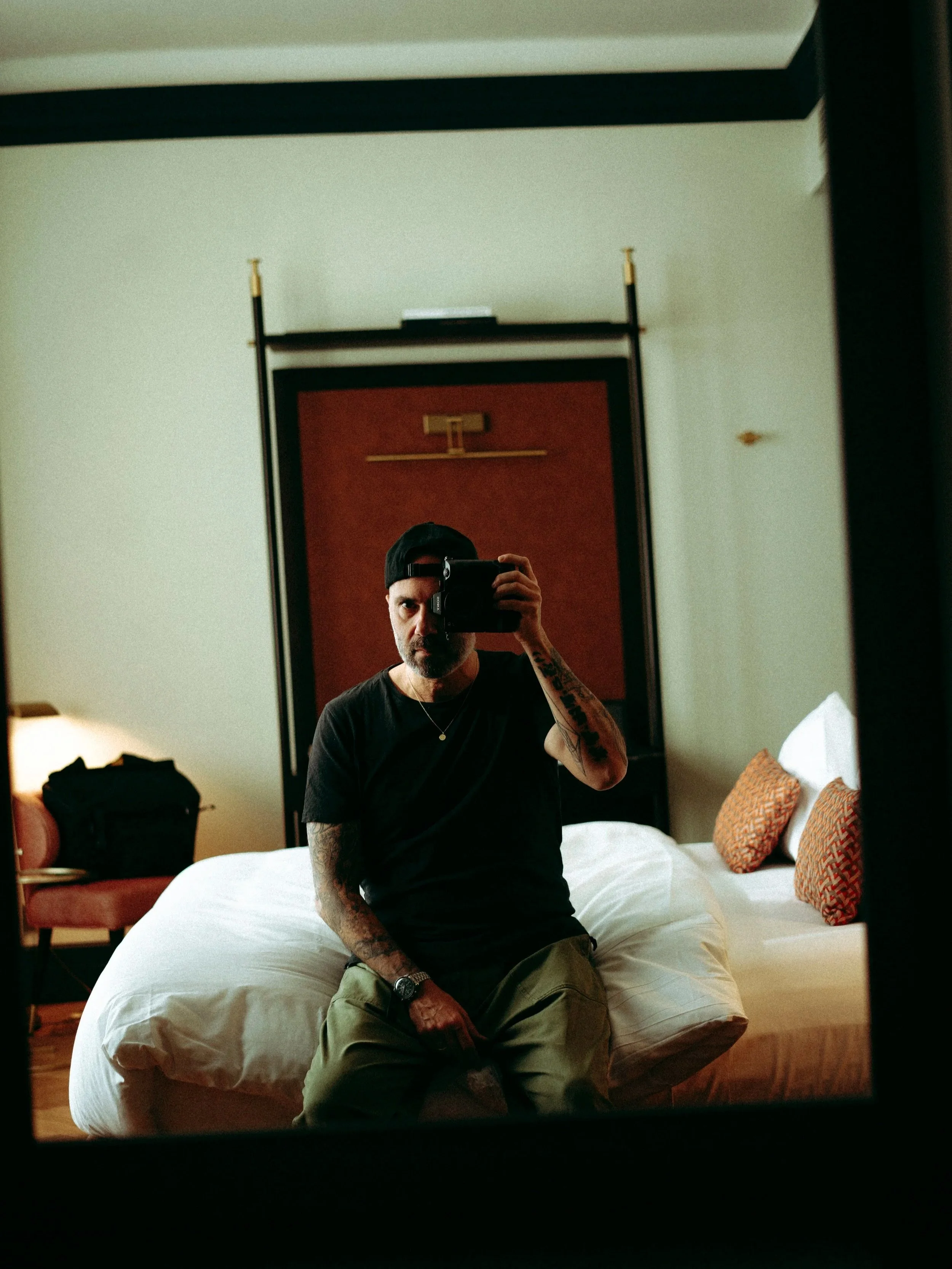
Self-portrait, 2024
It's the same in photography.
Visual language, style, look, quality, aesthetic impact – these are just facets of a much bigger question:
How much of myself is actually in my pictures?
Like I said, it's complicated.
I'll just give it a shot.
Maybe that's the point: talking about style means taking a risk.
Because as soon as you start revealing yourself, you make yourself vulnerable.
But perhaps that's the truth of it all.
When someone asks me how to find their style, I say: "To be honest, there isn't one single way. Style is a kind of resonance that echoes back when you start playing the right notes. Until then, I'm afraid you'll have to spend your time understanding it. But tomorrow I might answer differently."
Style is probably one of the most misunderstood topics in photography—and yet one of the most important. It's what defines your work, what sets it apart from others, and what gives it direction. Style isn't a decorative element; it's a foundation. It determines the aesthetic space you inhabit, the people you reach—and the ones you inevitably lose.
I believe there are two reasons why people concern themselves with style:
The first is the desire to differentiate themselves – to create something unique that bears their fingerprint.
The second is the need to belong – to show that they are part of a scene, that they understand what constitutes "good" photography, and that they can keep up technically.
Both are legitimate. But they lead in opposite directions.
One path is more uncomfortable, more honest, riskier – but more personal.
The other is safer, more predictable, smoother – but with the risk of remaining “only as good as the others”.
Personally, I prefer the first option, the imperfect, the unpolished one. I'd rather not be the most technically perfect photographer, but rather the one whose pictures are liked because they are mine.
Because they show a piece of my personality.
Because they say – in their own language – "This is how I see the world."
Because it's called visual language. And language is for expressing oneself, not just for communicating in a grammatically correct way.
The fingerprint
If you're wondering where your style is – it's already there.
It lies beneath layers of conformity, expectations, and comparisons.
It lies beneath the attempt to be "good."
Style isn't something you invent and "add on" to yourself; it's something you uncover.
I like to compare it to the work of a sculptor.
There's this raw block – your material, your potential, your personality.
And you begin, piece by piece, to chip away what doesn't belong.
With each blow, each attempt, each series, it becomes clearer what should remain.
But for that you need tools: skill, imagination, taste, patience.
If you don't have these tools, the work remains raw.
If you have them but don't use them, it becomes powerless.
And if you use them but aren't honest with yourself,
it becomes smooth, pleasing, but interchangeable.
Many people I meet in workshops or conversations already know deep down what their style is.
They sense it, but they don't dare to embrace it.
And I understand that perfectly. Because it takes courage to be honest about yourself.
Embracing your style also means risking rejection.
Some will love your work, others won't understand it—and both are perfectly fine.
Because without this risk, all that remains is safe, but empty, repetition.
So, style is always also a question of courage.
Who actually needs this information?
I sometimes wonder: Who is all this actually for – all these thoughts about style, about handwriting, about personality in photography?
And who can simply sit back and say: I just enjoy it – and that's enough for me.
I think there are roughly three groups.
Here's the first group, those who grapple intensely with the question of style.
Photographers who know that their work doesn't simply emerge in a vacuum.
That their own lifestyle—the music they listen to, the places they travel to, the books they read, the way they design spaces or conduct conversations—all of this inevitably flows into their photographic work.
They know that their own appearance, their demeanor, their outlook on life are part of their work.
These people ask themselves: Who are my role models? Who are my guiding stars?
What can I use as a reference point to develop further without copying someone else?
Then there's the second group – the seekers.
Those who know that something is there, that everything is connected,
but haven't quite pieced it all together yet.
They're currently discovering how style emerges, what influences it, and how a unique image slowly forms from many disparate elements – influences, encounters, experiences.
They're right in the thick of it, and that's perhaps the most exciting phase of all.
And finally, there are those for whom none of that matters – and that's perfectly fine.
Those who simply enjoy photography.
Those who see the light, love the technology, want to explore what's possible,
and perhaps don't even aspire to "develop" a style.
That, too, has its beauty.
Ultimately, it's not about who delves into it at what depth,
but about everyone finding their own approach.
Photography can be light. It can be serious. It can be both.
But those who delve deeper realize: the more personal the work becomes, the greater the risk.
Because with every picture, you reveal a piece of yourself.
And that can hurt—but that's precisely where style begins.
There's no accounting for taste.
I often say in my coaching sessions:
You can argue about style. You can't argue about taste.
Taste is not an opinion. It is a sense.
A feeling for balance, proportion, for the right measure.
It arises from observation, from experience, from life.
Taste isn't an innate talent.
It's the result of your curiosity—about how things really look,
how light falls, how people move, how you yourself feel.
Everything you see, read, hear, and love shapes it.
And this taste, in turn, is one of the most important ingredients in the recipe for your style.
If you lack discerning taste, your style will remain bland.
This isn't a judgment, but a logical consequence. (I inevitably think of cooking here, for those who find that part too abstract.)
But if you're willing to refine yourself—through art, music, encounters, travel—
then you sharpen your taste. And that sharpens your eye.
Ultimately, style is also a matter of inner aesthetics.
The building blocks of personal style
I often talk about how style isn't a destination, but a process.
There's no formula. But there are a few building blocks
that can help you recognize yourself in it.
Get out of your comfort zone.
David Bowie once said:
"If you feel safe in the area you're working in, you're not working in the right area.
Always go a little further into the water than you think you can. Right where you can only touch the bottom on tiptoe – that's exactly where you're meant to be..."
This sentence could just as easily have come from photography.
Style emerges where you venture a little too far –
where you risk failure but also discover something new.
Style arises where you take a small risk –
where you don't know if it will work, but you do it anyway.
Where you feel: Here I briefly lose my footing – therefore I'm on the right track.
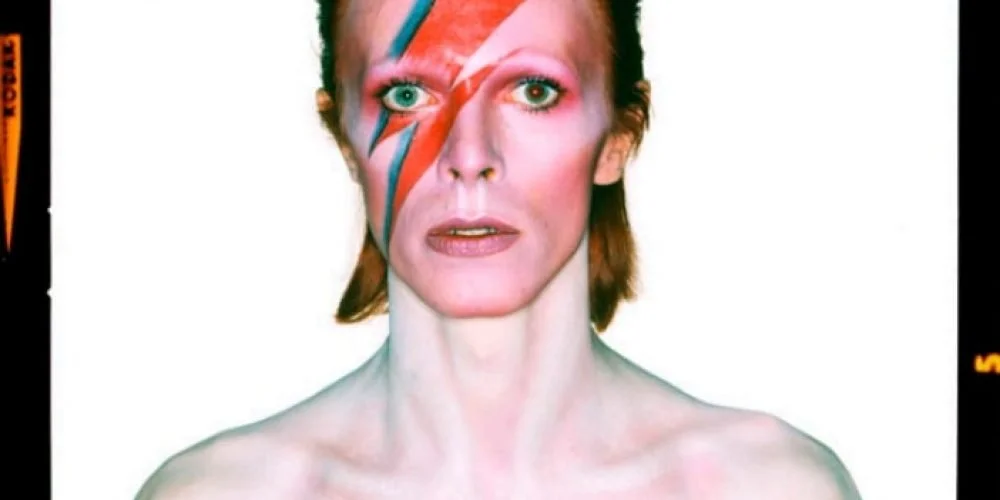
David Bowie
Don't pretend to be someone you're not.
Quirks, insecurities, minor flaws – these are all part of who you are.
They tell a story about you. But you have to honestly examine
whether they are truly a part of you – or just a matter of convenience.
Many people accept their weaknesses because they've grown accustomed to them.
But sometimes, that's precisely the point where you need to step outside your comfort zone.
fine – but in moderation.
Comparison isn't a bad thing. It can be inspiring.
Like playing music: at the beginning, you play songs by your favorite band.
That's important for learning technique.
But eventually, you have to write your own songs.
Comparison is a tool, not an end in itself.
And perfection?
Perfection is the death of all art, so they say. And I believe that too.
Because there is no measure for the perfect picture.
No criterion, no number, no moment at which you could say: Now it's perfect.
Perfection is stagnation. Style, on the other hand, thrives on movement, on breaks and the ability to endure them.
Cartier-Bresson and the first 10,000 images
Henri Cartier-Bresson once said:
"Your first 10,000 photos are your worst."
At first glance, this sounds strict, almost dismissive.
But in reality, it's a declaration of love for learning.
What he means is: You have to photograph long enough until you see yourself.
Until you stop repeating motifs you've seen somewhere else.
Until you start making decisions instead of just reacting.
The first 10,000 images belong to technology, curiosity, and the search.
The ones after that belong to you.
And the number 10,000 is more symbolic. In the age of digital photography, one could certainly add at least one more "0".

Henri Cartier-Bresson
But to get there, you have to persevere.
And that's perhaps the greatest risk of all:
working for years without knowing if you'll ever arrive.
But it's precisely in this uncertainty that the value lies.
You lose a part of yourself – and in doing so, you find something that no one can ever take away from you.
Because a language only develops over time – your rhythm, your perspective, your way of seeing and sensing light, people, and emotions.
And perhaps that is what style is all about at its core:
It doesn't grow through control, but through experience.
Through repetition, error, and that one moment when you suddenly realize:
That's me. Grown through many rejections, comments, and remarks (even those you never hear directly), trial and error.
Never for the gallery
And again, David Bowie. He once summed it up perfectly, even though he was talking about music.
He said something like: "Don't do anything for show. Don't work to meet expectations."
And the same applies to photography.
If you start taking pictures to please, to get likes, to meet expectations – then you lose something essential. Because at some point, you forget why you started in the first place.
Most of us started with photography because there was something inside us that wanted to be seen. Something we wanted to express in order to better understand ourselves.
And the moment you start producing for others, you lose touch with that inner source. (To continue Bowie's thought.)
I've often observed that the "worst" pictures are created when you try to meet expectations, when you play it safe because you think that's "professional." But the opposite is true:
safety leads to stagnation.
Style is not born of safety, but of risk.
Not of pleasing, but of discovery.
And never – truly never – for show.
Style as an attitude
I don't particularly like the word attitude "—it sounds too worn out.
Perhaps style is more of an attitude.
A conviction, a way of looking at the world.
Style is not a mask.
It is an extension of your personality.
It shows how you feel, how you choose, how you decide.
It is a reflection of everything you engage with.
It is what is there when you stop wanting to be someone else.
When you have worked long enough, doubted, discarded, and started anew –
then something forms that you can no longer shed,
because it is you.
Style is not a technique. Not a discipline. Not a goal.
It is the mark you leave behind.
For me, style is ultimately about this:
the courage to take a risk without knowing if it will be understood.
The courage to remain honest, even when it would be easier to shine. Even in the second or third tier.
And the realization that one's own unique style only becomes visible
when one is willing to risk more.