

Compendium No. 3 — PERSONAL – On photography, the unlived, and a conversation with Vincent Peters
October 25th.
On the way back from Istanbul to Frankfurt.
On the plane, I open my notebook and begin to outline a conversation structure. Questions I have for Vincent – and thoughts I want to share with him. Ideas that could lead us into a genuine exchange.
How do you talk to such a renowned photographer about his work—in a way that invites him to share more than what he's already said countless times?
I don't want to conduct an interview. I want to make him think. To tell his story. To remember.
The flight lasts about two hours and 45 minutes. For
two of those hours, I didn't put my pen down.
In the end, I'm surprised by how many thoughts I already had before the conversation even started.
You can't write about the book "Personal" without writing about Vincent Peters. Not about his technique. Not about his models. You have to write about what moves him. What he thinks about. What he sees—or doesn't want to see. Because the book isn't just a collection of portraits. It's a mirror. A reflection. It doesn't just show who stood in front of the camera, but how that moment came about. And why it lingers long after you've closed the book.
November 2025.
Paris and Frankfurt. Two cities, two voices on the phone. We're talking to each other—no camera, no image. And yet, one immediately forms in my mind's eye. Not of him. But of what's unfolding between us. I want to talk to him about his book, *Personal* , so I begin our conversation.
Our starting point is both serendipitous and personal: Viktoriia. A model. We both worked with her – he in Paris and Venice, I later in Sardinia and Frankfurt. And we both see her in the same way. Here we enter the first space of our theme. The same thread runs through our memories of her. Her face carries something within it that cannot be manufactured. No calculated gaze. No pose for the gallery. But something inner that shines through. Vincent says: "She has this energy." Something lasting. Even long after you've moved on.
And we quickly agree: Many people photograph them externally. Preferably naked. Or at least partially. Taking a picture, like a trophy. Like tourists who visit a landmark and think they've understood the city. But there are places—and people—that don't reveal themselves in passing. You have to immerse yourself. And that brings us right to the heart of the matter.
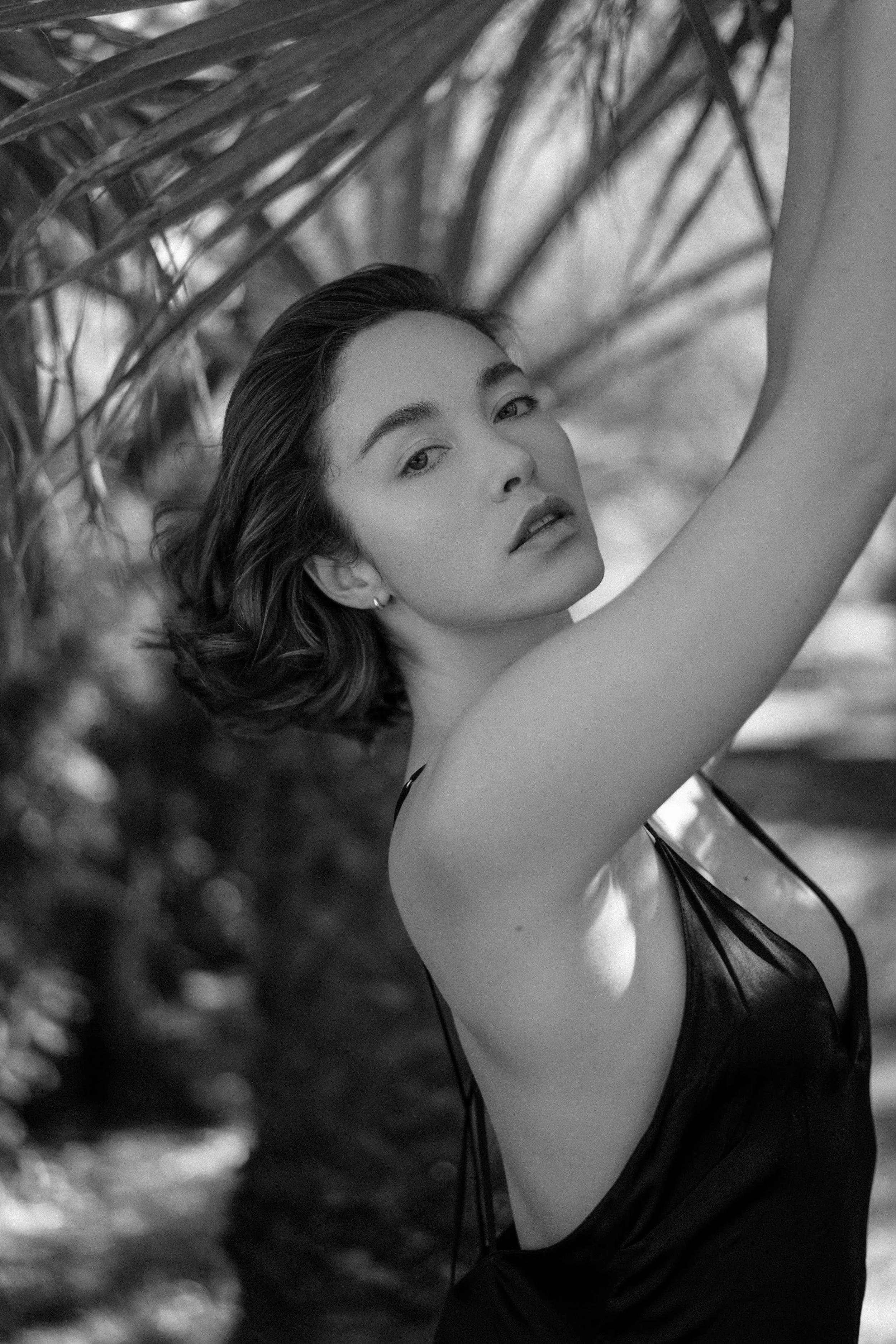
Victoria Sardinia 2024, Selim Say
Notes running over the edge.
I'm sitting at my desk, my notebook beside me. I write a lot. Quickly. Often just blindly, over what I've already written. Page two already, and we're still in the first fifteen minutes. Because if I want to write about personnel, I have to note down more than just data, facts, and quotes. I have to jot down the thoughts. The side paths.
What Vincent says isn't just a reflection on photography. It's a contemplation of relationships. Of life. Of what sustains us—or holds us back. Of where we come from and where we're going. We're circling around questions that have no easy answers. Why does a face move us? Why does a picture stay with us? When does photography become more than just capturing a moment?
Literature as Depth of Field:
To talk about photography is also to talk about life. About memory. Loss. Longing and connection. We talk about Proust. About Rilke. About Dostoevsky. Not to show off our knowledge of world literature. But because their books contain something that can also appear in a picture – if you allow it to.

Source: Vincent Peters Archive
“One must allow things their own quiet, undisturbed development,” Vincent Rilke quotes. He doesn't say this casually, but like someone who knows waiting. Someone who knows that depth takes time. That the right images aren't created in minutes or hours. But rather, at the right moment. What we read, the people we meet, the memories that work within us—everything flows into what we photograph. And what we haven't yet experienced sometimes lives on within us through an image.
“The future is fixed,” says Vincent, “but the present is open.” A thought that lingers with me for hours after our conversation. Perhaps the image is also an attempt to capture this openness before it solidifies. We continue our conversation, moving from room to room in the House of Themes.
Intimacy is not an effect
. Intimacy is not a trick. Not a stylistic device. It cannot be manufactured like a lighting setup. It is fleeting. It does not arise through routine – but through trust, patience, and through what develops between two people in a space when an atmosphere arises in which the unplanned is welcomed.
“Most people only show you the version of themselves that they tell themselves,” says Vincent. Being aware of this requires almost monastic patience. “But eventually, when they’re tired of telling the story, it happens. You see what lies beneath.”
Added to this is intuition. Not as talent, but as experience, reflected in nuances. A premonition born of restraint. I don't believe Vincent needs to delve into a person's inner world to take a good portrait. But he can open up a space. Create a neutral space. A kind of third place—beyond photographer and model. When this space exists, something can happen. And Vincent seems to master precisely that. So well, in fact, that the image emerges simply because the moment allows it.
The picture that doesn't happen – and then does.
Vincent describes how sometimes he simply waits. Everything is prepared. Set. Lighting. Outfits and styling. But nothing happens. No picture is created. Then he asks a question. Not a big one. Not one related to the shoot. Something like: "What do you miss most right now?"
And suddenly something changes. His posture. His hands. His gaze. And then: the picture. Sometimes he takes the same picture five times. From the outside, there's hardly any difference. But for him, between the third and the fifth lies a small truth that only he senses. Such pictures made it into the book.
Technology as a stage, not as content.
We also talk about light. About composition. Black and white. Nuances. I work a lot with natural light. Vincent controls it, uses it deliberately. And yet we agree: No light, no camera, no post-processing can save a picture if the atmosphere is missing.
Technology is the stage. But what matters is what happens on it. Many have mastered lighting, camera work, and image editing. But they lack that one element that cannot be taught. It arises in the situation, spontaneously, in the moment.

Source: Vincent Peters Archive
Vincent has been photographing on 120 analog film for decades, using a Mamiya RZ and a 110 lens. There's something of the old craft about it. But it's more than that. I see it as a counterpoint to our current obsession with optimization – digital, perfect, predictable. It's a conscious imperfection, a "willful ignorance," a waiting, an openness to the uncontrollable.
What a picture can convey:
A good picture shows not only who or what someone is, but perhaps also what they never became, or what they could be. That which is missing, the unlived. But not as a deficiency, rather as part of a whole.
Vincent says: "If something works too well, it's often not real enough." Often the right picture is the one you almost deleted.
Personal – the personal in the unplanned.
I ask him why the book Personal . “Because that’s what it is,” he says. Personal.
Many of the images were never intended for public viewing. They simply happened. Between sets. Behind the scenes. Without a complete lighting setup. Without planning. Without a goal. And that's precisely why they work. Because they don't need to tell a story. They're more like snapshots taken with a "let's just take a few more like this" attitude.
Beauty Without a Recipe
. We're talking about beauty. What it means to him. And to me. And why it can't be reduced to the surface. Not to lines, proportions, light. Beauty isn't smooth. It's a story that isn't finished. A contradiction that can't be resolved. A tension that remains because the viewer has to engage with it.
One lingering question:
In Personal , one encounters many beauties. Actresses, models, faces in perfect light, poses full of control. And suddenly, right in the middle: Monica Bellucci – with a toddler in her arms. Another image shows a woman with her son in bed. Or a girl sitting lost in thought on a table. Images that stand out. They seem almost forced into the choreography of the productions.
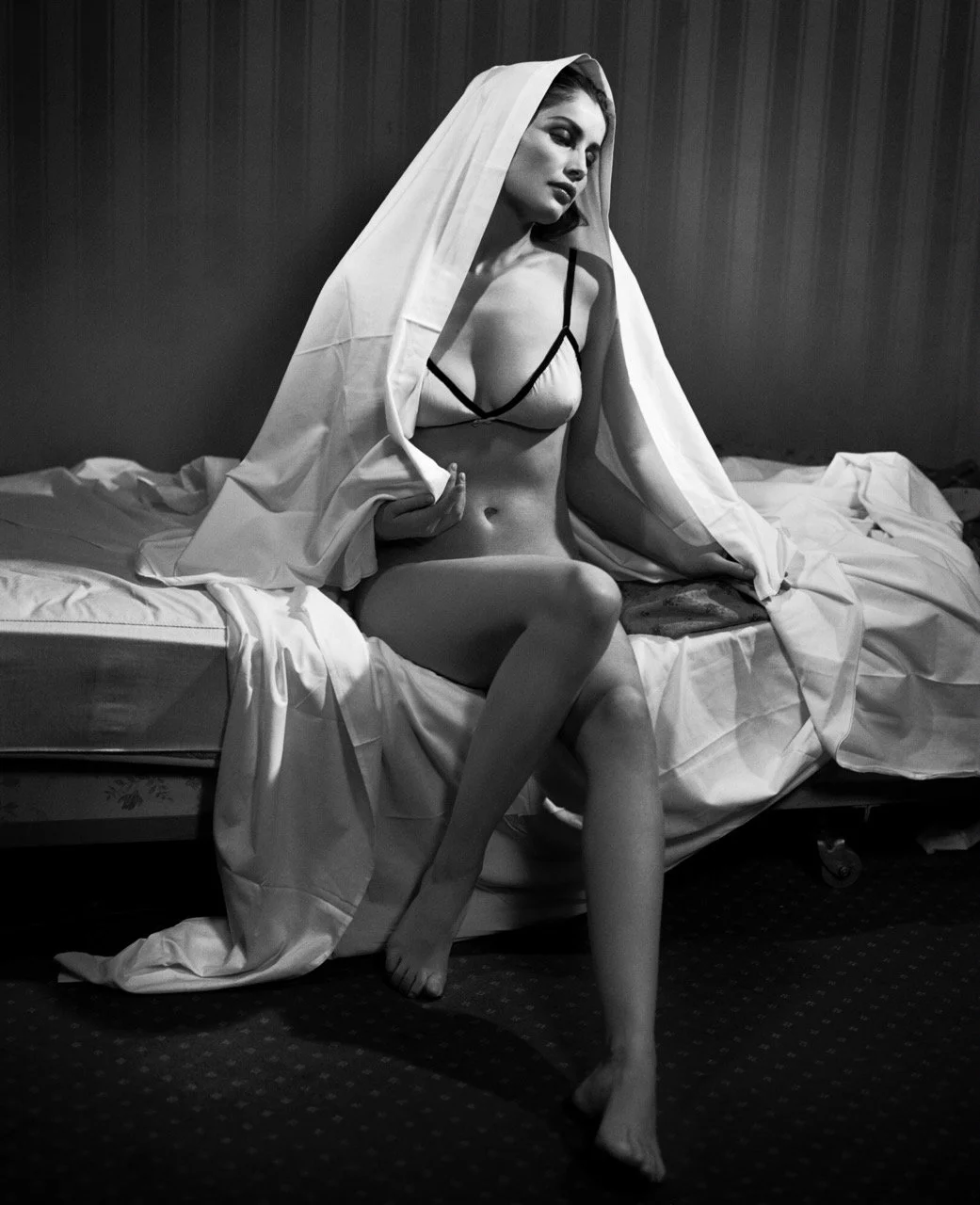
Source: Vincent Peters Archive
I've thought long and hard about how to categorize this. Is it a deliberate disruption? A break? A statement? Perhaps because the images aren't just about beauty in the classical sense, but also about connection. The pictures in this book don't follow a dramatic structure, but rather a biography. They don't tell the story of a series, but the story of a life with a camera. And that includes moments that don't fit into a perfect concept.
To this day, I don't know if these pictures in the book bother me. But perhaps that's precisely their function: moments that hold personal meaning for him. And even though there are only a few of them compared to the other photographs, they raise questions. And perhaps that's their purpose.
No period
. When we say goodbye, we don't conclude anything. We don't end it. No final sentence. We laugh about how quickly time flies and how there's still so much more we could talk about. But I have to wrap things up. I look at my notebook. Page four or five. Many of the thoughts are scrawled across old sentences.
After our conversation, I think about Vincent. About what he said. About his camera, which has accompanied him for decades. About his pictures, in which you recognize something that is more than just a face.
I wonder: Does he operate according to a different calendar? And what does it mean for my own photography if the future is fixed – but the present is open? I believe that's precisely the point: not to capture the perfect, but the open, before it becomes fixed.
A thought that stays with me. Even with the next picture I take.