

Fragments of Light No. 12: What holds a style together
A few weeks ago, someone told me my style had changed.
Even more than that: that my earlier pictures were "more me."
I don't think it was even meant as criticism. It came up casually in conversation, and somehow it resonated with me. Not because I felt attacked or criticized, but because the question touched on something that had been lurking in the background of my thoughts about style and photography for a long time.
I'm no philosophy expert, but when I'm thinking about this and that, I keep coming back to this field and encountering stories that I can use as a guide. Just the other day, I happened to be reading about Theseus's ship again. It's one of those stories you hear once, forget about, and then rediscover years later one evening because it resonates with your own life and way of thinking.
The story of Theseus:
His ship was cared for over generations. Every time a plank broke, it was replaced with a new one made of the same wood. This went on for decades, for centuries. Eventually, no original piece remained, and yet people still said: This is Theseus' ship.
Later, someone built a second ship from the old, collected planks.
Now there were two in the harbor.
Which one was the "real" one? Philosophers have grappled with this question for centuries and have yet to reach a definitive answer.
Some say: The identity lies in the material.
Others: It lies in its uninterrupted existence.
Still others: It lies in its function.
Then there's Heraclitus, who said: Nothing stays the same. Everything flows. You don't step into the same river twice.
Then there's Plato, who said: What counts is the idea behind the form.
The deeper I delved into it, the more I realized how much it all (also) has to do with photography.
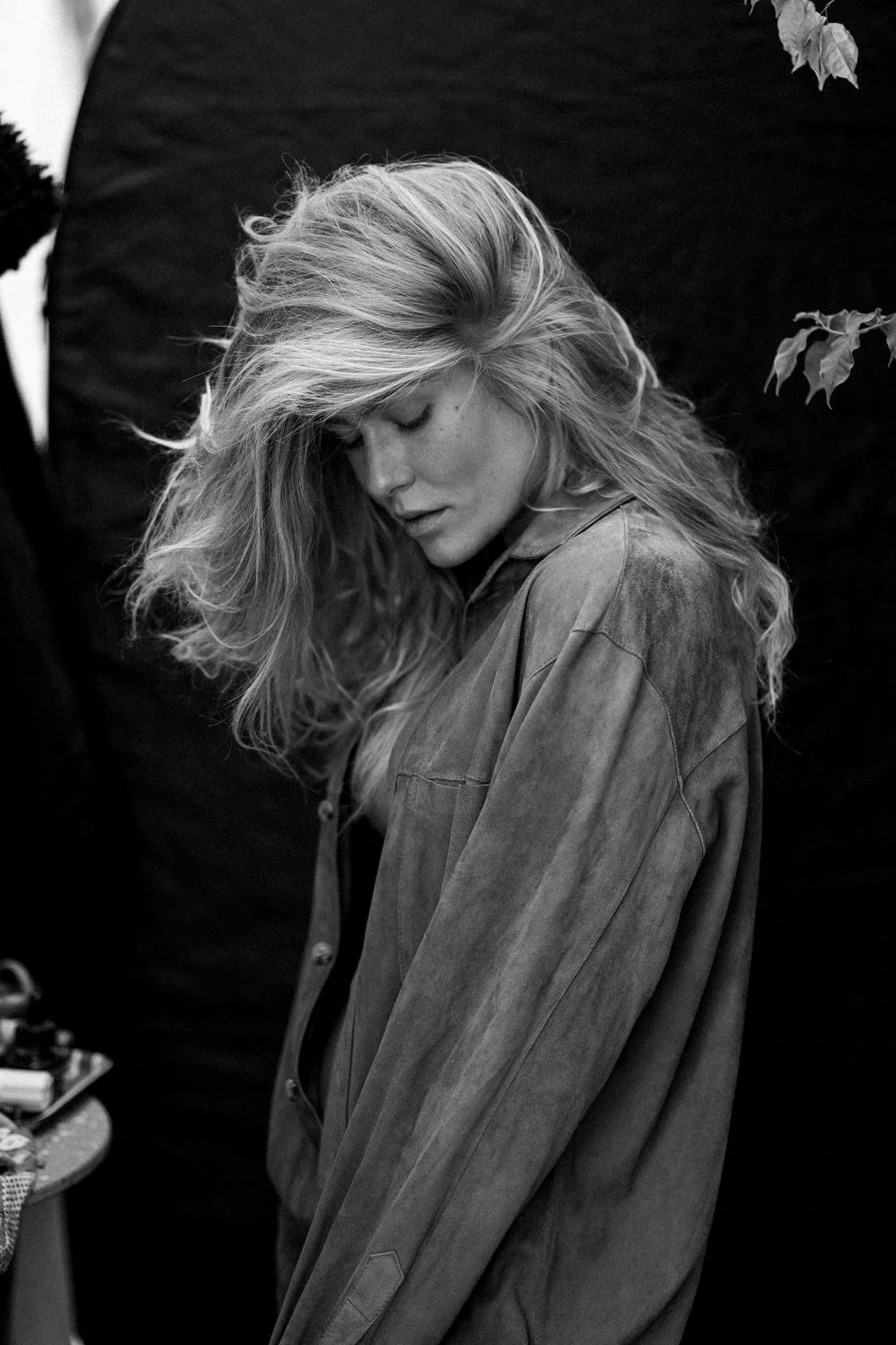
Anna, 2018
Change comes in small steps.
Looking back on my own photographic development, I see precisely this process:
plank out, plank in.
Small changes that are barely noticeable at the moment—but in retrospect, they transform entire spaces. When I give lectures and talk about (my) development, comments about this often come up. People say they can't really see any difference between the pictures from a few years ago and those from today.
My first black and white photographs were often heavily inspired by other photographers. I only started photographing intuitively much later, experimenting little, and gradually understanding how to bring together light, people, and the moment.
Later came other phases:
calmer, clearer, with more space between me and the subject.
Then again closer, more direct, almost physically close, just an arm's length away.
And eventually color, first cautiously, then confidently with my own formula.
But none of it was a break with what had previously excited and inspired me.
They were transitions, modifications, new planks for my ship, so to speak. I also added new parts and removed others.
"Your style used to be more like you." Okay, I also tend to overthink a bit, and on some days such statements make me feel insecure.
The illusion of the original
Style, for me, isn't something fixed or unchanging.
And if you photograph long enough, you realize: the original "ship" never existed.
There were only ever versions. Layers. Points in time. And each with its own movements. On different waters.
Style is less an identity than a direction.
An inner compass. A kind of magnetic field that cannot be replaced, no matter how many planks are replaced.
I look at other photographers:
With Newton, it wasn't the technique, but his way of choreographing bodies.
With Lindbergh, it was this unwavering interest in the person behind the image.
For Purienne, it is the fleeting, the unprepared, that runs like a common thread through his work.
They all rebuilt their ships countless times. But the compass remained the same.
The second ship: Nostalgia and old phases
There is another thought from the Theseus Paradox that particularly resonates with me:
What happens to the old parts after they have been replaced?
The philosophers debate this:
Does this create a second ship — a kind of shadow version of the old self — or is it the “real” ship?
In photography, I often see this second ship in the form of nostalgia.
We all have old pictures, old phases, that we look back on and think:
There was something purer, more immediate, freer back then. It was like this, one way or another.

Greta Louisa, 2019
But for me, that's a mistake.
We don't miss the images, but the time in which they were created.
The version of ourselves that existed back then.
The places, the people, the perspective that didn't yet know what it would one day know.
This second ship is important, but it's not meant to sail again.
It's an archive.
But the journey takes place on the new ship and on the next one.
What remains in the image?
If I consult philosophy, it roughly distinguishes three approaches:
1. Material identity
A thing remains itself as long as its parts are the same.
Applied to photography:
"My" style as the sum of the means as they are composed of my camera, the focal length, the color tones and values, the lighting, etc.
But that would be a reductive view.
Because if that were true, one would have to say: I take different pictures today—and therefore different photography.
But I think that's wrong.
2. The Uninterrupted
A thing remains itself as long as its story is unbroken.
That fits better:
I've never stopped taking photographs or interrupted my practice since I started doing portraits.
Even though color, light, proximity, and rhythm change, I haven't abandoned my path.
3. Functional Identity
A thing remains itself as long as it fulfills its purpose.
And this is precisely where things get interesting: What is the "purpose" of my photography?
Is it about creating intimacy?
Is it about making atmosphere visible?
Is it about showing people as they cannot see themselves?
Is it about capturing emotions?

Mareen, 2019
It all remains the same, even when the form changes.
And that's precisely this functional level, what holds my images together, even when their outward appearance changes.
We ourselves are ships
The most philosophical twist to this paradox is also the most personal:
We are all Theseus ships ourselves.
Our bodies renew themselves. Our memories change. Our beliefs grow, shrink, and crumble. Whatever it is, something is always happening.
We are an unbroken line of experiences, yet always new versions of ourselves.
And that's precisely why the remark "Your pictures aren't like they used to be" is both right and wrong at the same time.
Of course; because I'm not like I used to be.
Of course; my style isn't like it used to be. How could it be? Why should it be?
But at the same time:
I am still me.
And my style is still an echo of myself — not despite the changes, but through them.
Identity is not a static place. It is a river. Just as Heraclitus saw it.
Style is this river that changes with every bend, but is fed by the same source.
This is the most beautiful form of continuity that a person, a photographer, a musician, can have.