

Fragments of Light No. 10: My last photoshoot
Admittedly, the title sounds a bit dramatic. But I'll try to explain.
Occasionally I give workshops or mentor a photographer. It's almost never about technology. Not about cameras, lenses, or other nerdy talk. It's about the question: Why do you actually take photographs?
I then talk about my own photography, not as a reference for "doing it right," but as an example. And I ask questions:
What do you want to communicate?
If your session were a film – which scenes would be the key moments, and what could be cut?
How do you express yourself in your pictures?
And what do you want people to think about you when they see your photography?
Don't say you don't care.
In these conversations, I often see how difficult these questions are. You can sense the hesitation, the searching for words. Even in groups, when there are six to eight people sitting around me. It reminds me of training. A coach can show you how to lift weights and prescribe exercises. But if you don't change your mindset, you'll stagnate. You won't progress with the old movements. At some point, you have to let go of something or change it if you want to get stronger. In individual coaching sessions, I'm an understanding but very honest sparring partner.
I recently had a photographer at this point. Clean, clear images, technically good. But she felt it wasn't enough. She wanted her pictures to be more intense, more emotional, more narrative. So I asked:
"What are you actually looking for in the people you photograph?"
She looked at me, thought for a moment, and I had to think about myself.
To my last photoshoot.
The studio was already empty, the music still playing. I drank my coffee, which was long since cold. The camera lay on my lap. I clicked through the pictures. There were eyes that sparkled. A smile, a hint of sensuality. Exaggerated, almost contrived. But in the picture, it looks real.
A moving body. A blouse. A bodysuit. Ingredients for a beautiful photograph.
But was it really a portrait? Or just a staged scene?
I used to want to tell stories. Now I sometimes realize: my pictures tell my story more than the stories of the people in front of my camera. And that's precisely where change begins. Quietly, without a bang, often quite imperceptibly. You simply have to "look."

I was thinking about a conversation I had recently. Someone told me, "You can't even see the change in your pictures."And he compared it to cars. Electric or gasoline – from the outside, there's hardly any difference. The comparison was banal, but it stuck with me.
Perhaps it's the same in photography. Some start out freely, without a legacy, without obligations. Start-ups can enter the market wherever they want. Large brands, on the other hand, have to rethink their approach, let go, and rebuild their systems. A restart isn't always possible.
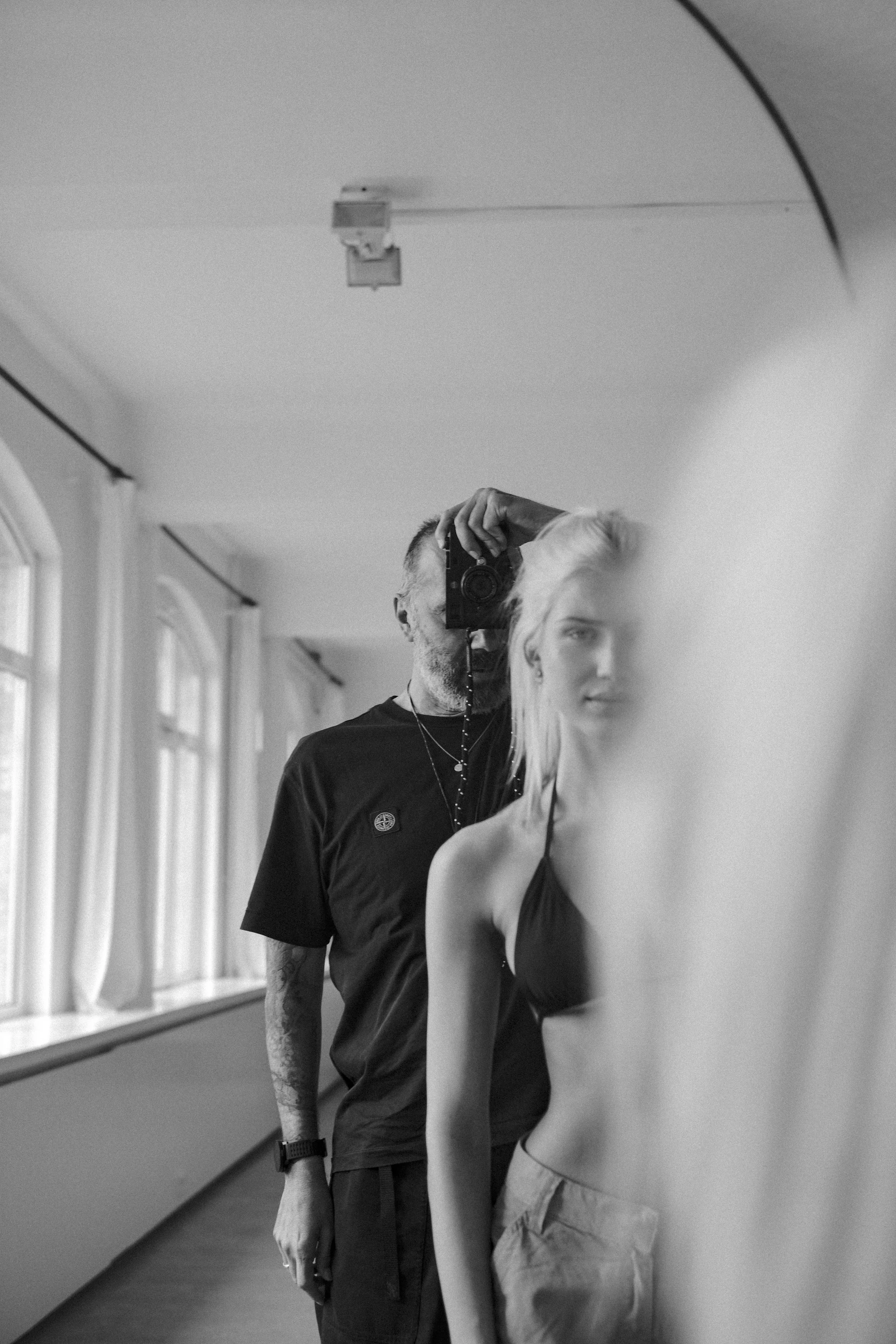
With Paulina 2024
I'm also thinking about filmmakers. Some have a framework, a working method, a studio with high expectations and specifications behind them. They rely on a few big cards – and eventually realize that small, specialized studios are overtaking them. Simply because they can start wherever they want. Because they don't have to let go of anything that means something to them.
It's not about the loss of something I had.
It's about the loss of something I would never get if I don't stop doing certain things.
To portray someone – that should be taken literally. Not to make them more beautiful, not to smooth them over. But to make visible who they are. With everything that entails: joy, fear, loss, idiosyncrasies. Pleasant or not. That's what it's about for me. Not about the perfect pose, but about being there. Being together. From person to person.
I looked at the camera. And somewhere between switching it off and packing it up, I knew: That was my last shoot of this kind.
Not as an end. Rather as a beginning.